Division of Infectious Diseases

UNMC Infectious Diseases Fellows are Antibiotics Aware

The following was written by Dr. Raj Karnatak, 2nd year ID fellow at UNMC; a reflection of his current Antimicrobial Stewardship/Infection Control rotation:

The UNMC Infectious Diseases fellowship antimicrobial stewardship and infection control rotation provides robust training for fellows in both antimicrobial stewardship and infection control. Training is well designed with education in all the core elements of stewardship and infection control. Fellows attend dedicated lectures from the experts in the field of infection control and antimicrobial stewardship. Throughout the rotation fellows actively participate in hospital acquired infections (HAI) surveillance and infection prevention, and antimicrobial stewardship interventions. In the Infection control training, we learn about the role of healthcare epidemiology, surveillance and prevention of healthcare-associated infections including C. difficile, central-line associated bloodstream infections, multidrug-resistant organisms, ventilator-associated events, and surgical site infections.
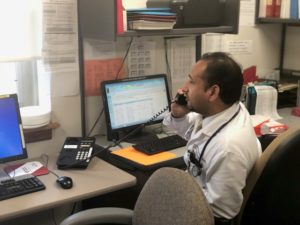
Our antimicrobial stewardship training is concentrated on learning the CDC core elements of antimicrobial stewardship and implementing principles of antimicrobial stewardship in healthcare settings (Inpatient, outpatient, long-term care facility). Fellows actively engage in quality improvement in the infection control and antimicrobial stewardship and also work closely with our Stewardship Pharmacy Coordinator. Learning stewardship core elements present you to principles that can very well be applied to a wide variety of QI efforts. As fellows we are fully integrated into the stewardship team during our rotation, and besides attending key meetings where brainstorming stewardship issues occur and decisions are made, we actively participate in daily telephone audit-and-feedback. This gives us needed practice with communicating with prescribers, troubleshooting common problems and helps us to be better Infectious Disease Doctors.  We are also participating in the IDSA Antimicrobial Stewardship Curriculum pilot. In this formal training, our curriculum Directors Drs. Van Schooneveld and Marcelin meet with us regularly for case-studies, role playing and module reviews, where we discuss approaches to handling difficult situations as #Stewies.
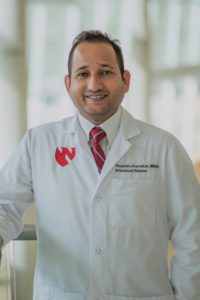
As a part of my stewardship project, I am working on developing an institutional guidance document for antibiotic management of acute rhinosinusitis and pharyngitis in the outpatient setting. My other project is in infection control for the prevention of ventilator-associated events. I also had the opportunity to work with a larger multidisciplinary sepsis group for the development and implementation of institutional sepsis protocol. As a budding Infectious Diseases physician with particular interest in Critical Care Medicine, I know that Antimicrobial Stewardship is essential to any job I take post-fellowship, and I am thrilled to be at an institution that values it so highly.
How Nebraska ASAP is Making Everyone Antibiotic Aware

The following was written by Dr. Salman Ashraf, co-Medical Director of the Nebraska Antimicrobial Stewardship Assessment & Promotion Program (ASAP):

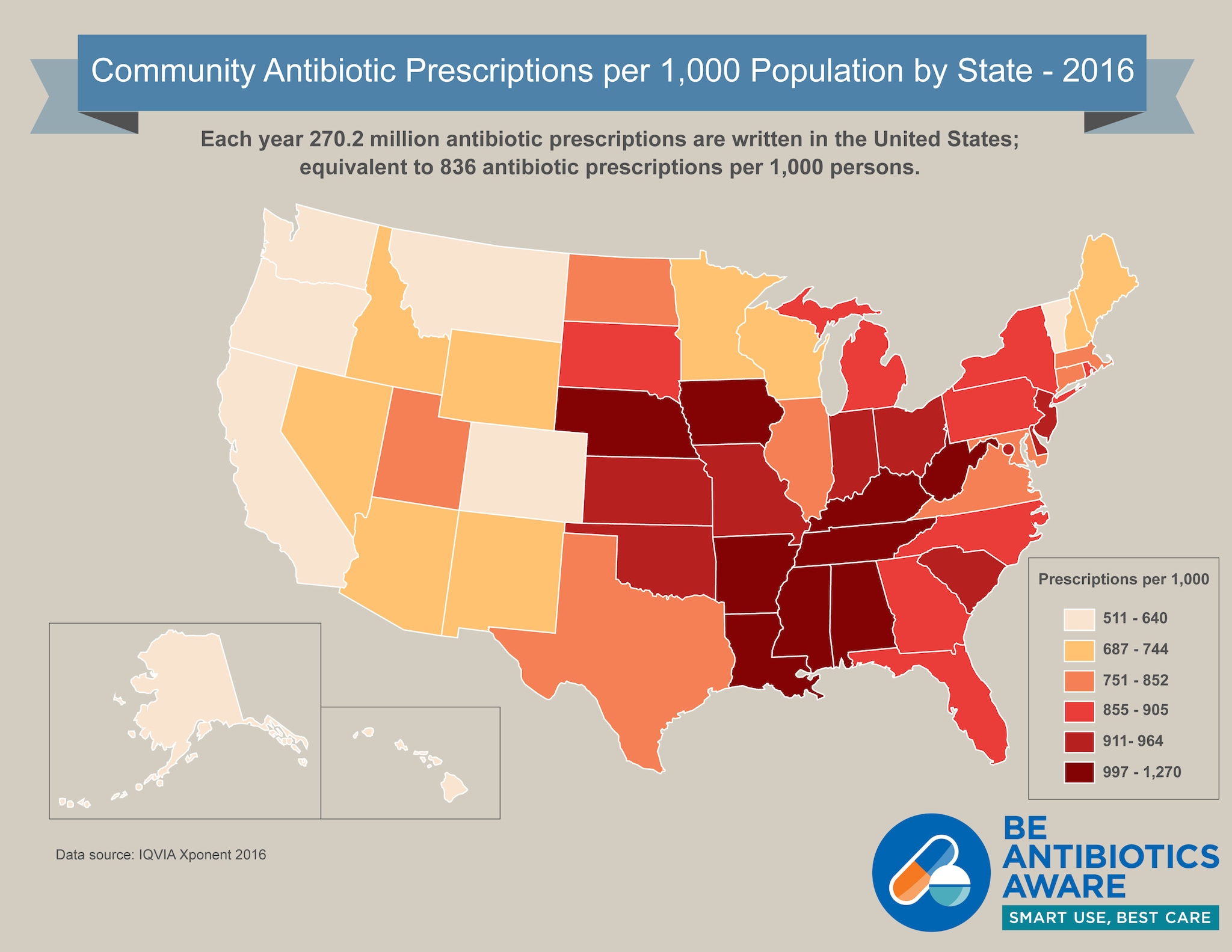
Antibiotic Resistance is one of the most urgent threats to the public health. Overuse and misuse of antibiotics allows the development of antibiotic-resistant bacteria. Unfortunately, a significant proportion of antibiotic use in various healthcare settings continues to be unnecessary or inappropriate. About a third (30%) of all antibiotic use in hospitals and outpatient setting and up to 75% of antibiotic use in long-term care facilities have been found to be inappropriate. Antimicrobial stewardship programs (ASP) have been shown to be effective in decreasing inappropriate antibiotic use in all of these settings. However, there is a shortage of infectious diseases (ID) trained physicians and pharmacists who can assist healthcare facilities in such efforts, especially in heavily rural states such as Nebraska. Additionally, many of these facilities may lack the resources necessary to effectively implement an ASP.

The Nebraska Antimicrobial Stewardship Assessment and Promotion Program (ASAP) is funded by the Nebraska Department of Health and Human Services, Healthcare-Associated Infection Team through a CDC grant. It is closely affiliated with the nationally recognized ASP at Nebraska Medicine. The ASAP program employs ID trained pharmacists, ID trained medical directors and infection preventionists with extensive experience in establishing and running successful infection control and antimicrobial stewardship programs. The goal of ASAP is to promote effective use of antimicrobials and improve patient outcomes throughout the state of Nebraska by collaborating with local clinicians, pharmacists, infection preventionists and other health care workers. The team is working diligently to establish effective ASP in all healthcare facilities, especially those that lack the expertise to develop or improve these programs on their own.

The highlights of Nebraska ASAP initiative include:

• Assessment of ASP in various health care facilities
• Identification of facility-specific gaps along with provision of recommendations for improvement
• Provision of ongoing support for antimicrobial stewardship efforts in recruited acute and long-term facilities through an innovative model of remote coaching (utilizing video-conferencing service)
• Development of tools and templates to facilitate implementation of ASP in various healthcare settings
• Development of patient and provider educational resources related to appropriate antibiotic use
• Collaboration with regional organizations and healthcare facilities on educational efforts to improve antibiotic prescribing practices in outpatient setting
• Provision of expert guidance related to ASP development and maintenance for all healthcare facilities that reach out with questions (in addition to assisting healthcare facilities in Nebraska, the team also answer questions sent to us by facilities and organizations from neighboring states or other parts of the country).

Notable achievements of Nebraska ASAP initiative include:

• Currently providing expert guidance to 24 facilities in the state (10 acute-care Hospitals and 14 long-term care facilities)
• Created a website focused on promoting ASP in healthcare facilities by providing tools and templates specific to the different healthcare settings
• Since its inception in August 2017, the Nebraska ASAP website has been visited by over 5000 users both nationally and internationally and has earned the reputation of a national resource for facilities looking into developing or improving their ASP
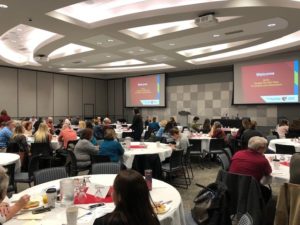
• Organized the inaugural “Antimicrobial Stewardship Summit” for the state of Nebraska on June 1st 2018 to provide education to ASP program leaders (over 250 healthcare workers attended the summit)

• Established the Nebraska ASAP YouTube Channel in February 2018 that hosts all the educational videos developed by the team (almost 2500 views of the videos have been reported in this short time frame).
• Shared our findings and experience with healthcare community at various national meetings (these presentations are available online here
• Piloted an educational intervention in 10 primary care clinics that resulted in a 25% decrease in antibiotic prescribing for acute bronchitis (further analysis is ongoing and the results will be shared with healthcare community soon)

Upcoming activities of Nebraska ASAP initiative include:
• Introducing a CME educational activity for providers of outpatient clinics and urgent care centers. The course will be launched in the next couple of months. Outpatient clinics and urgent care centers who want to partner with ASAP can reach out to us in advance to make sure they have a guaranteed spot when the activity goes live: Further information can be found at online here
• Organizing the 2019 Antimicrobial Stewardship Summit that will focus on the needs of acute-care, long-term care and ambulatory-care settings. The summit will not only provide guidance on how to establish ASP but also provide education on evidence-based management of common infections in various healthcare settings. To receive news on important new website contents or upcoming events sign up for updates here
• Continue to recruit for remote coaching on antimicrobial stewardship (only a few spots left). Healthcare facilities that are interested in partnering with antimicrobial stewardship experts to assist their local ASP team can find more information on the following link:

The Nebraska ASAP team

Nebraska Medicine is Proud to #BeAntibioticsAware

Our Antimicrobial Stewardship Program (ASP) at Nebraska Medicine has been in place since 2004. Over the years our program has changed and improved sought to expand and improve its approach with the goal of providing extraordinary care to our patients. Rather than an overly restrictive practice, our program has we have emphasized constant regular communication with our clinicians through a robust audit-and-feedback program. Physician medical directors are Drs. Trevor Van Schooneveld, Jasmine Marcelin and Erica Stohs, (who recently joined our program this summer). Our Pharmacy Coordinator is Scott Bergman PharmD.

Over the last year, our ASP team has collaborated with the microbiology laboratory, hospital clinical effectiveness team and sepsis taskforce to implement some changes with goals of improved patient care.  In June 2018, we hosted the inaugural Nebraska Antimicrobial Stewardship Summit, where experts spoke on various aspects of ASP.  This has led to multiple outreach conferences where members of our ASP team have been invited to speak and counsel medical centers on their ASP development.

Diagnostic stewardship has become an integral part of our ASP. We implemented a hard stop in the electronic medical record to prevent inappropriate ordering of the gastrointestinal pathogen panel and saw significant decreases in inappropriate use with associated cost savings (Presented at #IDWeek2018). Similar interventions are underway for decreasing inappropriate respiratory pathogen panel ordering and C. difficile testing.  A larger C. difficile reduction project is ongoing hospital-wide, and antimicrobial stewardship plays a significant role in this.  Additionally, we have updated several clinical guidance documents including alternatives to vancomycin + pipercillin/tazobactam combination therapy to avoid renal injury, skin & soft issue infections, and published an approach to inpatient allergy management.

We are also focusing efforts on Outpatient Antimicrobial Stewardship. While this program is still in its nascent stages, in collaboration with Nebraska ASAP we have developed a series of resources for antimicrobial stewardship in the outpatient setting including educational modules. The program goals are to reduce unnecessary antibiotic prescribing in the ambulatory setting throughout the Nebraska Medicine network.

Finally, the stewardship team has been working the Nebraska Medicine Sepsis Committee to assist in developing a management strategy for this common and highly lethal condition.  Initial work focused on sepsis recognition and implementation of screening to identify patients for early intervention.  This was highly successful with a 47% decrease in sepsis mortality at Nebraska Medicine between 2014 and 2016.  With the recent introduction of new sepsis definitions the Sepsis Committee elected to implement these new definitions to better focus aggressive care on those patients most likely to benefit from it. In addition, the current nurse screening protocol is being replaced this month with an advanced sepsis early warning model which mines large amounts of data available in our electronic record to more accurately identify patients at risk of developing sepsis.

Over the years the mission of the ASP at Nebraska Medicine has not changed, but our methods and activities have expanded to meet the challenges of our ever changing healthcare landscape.

Keep looking for updates to clinical guidance on our website!

Content courtesy Dr. Trevor Van Schooneveld and Dr. Jasmine Marcelin

Governor Ricketts Proclaims Antibiotic Awareness Week in Nebraska

Last year, Nebraska’s Governor Pete Ricketts signed a proclamation declaring Antibiotic Awareness Week in Nebraska, and he again signed a proclamation this year, declaring November 12-18 Antibiotic Awareness Week in our state. Once again, Dr. Maureen Tierney, leader of Nebraska’s Healthcare Associated Infections Program, championed the drafting of the proclamation and received support from the Governor for this observance.

Formerly known as Get Smart About Antibiotic WeekUS Antibiotic Awareness Week is an annual observance designated by the CDC to bring awareness to healthcare professionals and the public on the threat of antibiotic resistance and the importance of using antibiotic appropriately.

The CDC has prepared a partner toolkit for institutions that want to participate in this event. The toolkit contains key messages, social media content (#AntibioticResistance, #USAAW18, #BeAntibioticsAware), graphics and more. Below is a sample of events that will be promoted during each day of the 2018 Antibiotic Awareness Week.

Monday, November 12

  • Special edition of the CDC Safe Healthcare Blog which will feature a story on successful implementation of antimicrobial stewardship program for veterans
  • Publication of an article that describes drivers of inappropriate antibiotic prescribing and potential interventions

Tuesday, November 13

Wednesday, November 14

Thursday, November 15

  • Kick-off of a global Twitter storm from 8am-9am CST with the hashtag #AntibioticResistance and the message “Antibiotic resistance is one of the most urgent global health threats. Everyone has a role to play in improving antibiotic use to help fight #AntibioticResistance”
  • New antimicrobial stewardship core elements for resource-limited settings

Friday, November 16

During this week, also look for blogposts from Nebraska ASAP and UNMC Division of Infectious Diseases on antibiotic stewardship and appropriate antibiotic prescribing.  We are excited for this year’s events and we hope you will participate in this important patient safety and public health initiative.

Content provided by Phil Chung PharmD and originally posted to the Nebraska ASAP website on November 6, 2018. 

Does the Clostridium Smell Diffy? Even the Dogs Disagree…

The C. difficile sniffing dogs are back! There are several prior reports of individual dogs being trained to “sniff out” C. difficile. In a novel approach, the authors of this study trained two dogs simultaneously, and then compared interrater reliability between sniff attempts. They used toxigenic C. difficile frozen stool samples (GDH EIA and PCR positive) and negative controls in an institution where prevalence of toxigenic C. difficile was 13.7%. A German Shepherd and Border Collie Pointer each trained with a reward based system, first detecting toxin-producing C. difficile then detecting negative samples (Click here for a cool training video). The dogs then sniffed 300 validation stool samples in identical boxes (30% positive 70% negative), with 10 random samples for each detection round.

The dogs had a moderate interrater reliability with a Cohen’s kappa of 0.52. Both dogs had about 85% specificity of toxigenic C. difficile detection but the German Shepherd’s sensitivity of detection out-sniffed the Border Collie Pointer (92% vs 78% respectively). Positive predictive value for both dogs was <50% and negative predictive value was >95% for both dogs. Interrater variability necessitates individualized dog training; and it is curious that two different species were used – could there be a genetic predisposition for “better” olfactory receptors in certain species?


Trained Giant African pouched rats can accurately sniff tuberculosis in Tanzania, and dogs have been trained to detect drugs and explosives for law enforcement, so why not C. difficile?Though the concept is exciting, this is miles away from mainstreaming due to effort and lack of generalizability.

If two different canine species could not agree on whether or not the stool smelled “diffy”, where does that leave humans, whose olfactory capabilities are thought to be 10,000- to 100,000-fold less sensitive than dogs? Perhaps when it comes to C. difficile, no nose knows better than conventional testing.
The preceding was previously posted by Dr. Marcelin to SHEA Journal Club published online in October. Article reviewed: Maureen T Taylor et al. Using Dog Scent Detection as a Point-of-Care Tool to Identify Toxigenic Clostridium difficile in Stool, Open Forum Infectious Diseases 

IDWeek 2018: Why We Still Don’t Wash Our Hands

At IDWeek 2018, the annual conference for the Infectious Diseases Society of America, I was struck by one simple truth.

We are still talking about washing our hands, or in our professional lingo, hand hygiene.

Hand hygiene is the simplest, most effective way to prevent infection. Most of us know this intuitively, without the science, as we grew up being reminded by our parents and teachers to wash our hands. It simply makes sense. Our hands are the most exposed part of our body and are in constant contact with our non-sterile environment (fecal veneer, anyone?). If someone does not wash their hands in the restroom, we are aghast. Don’t they realize that is a health risk?

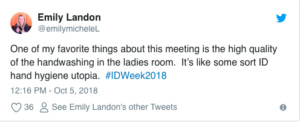
This issue even resulted in an #IDWeek2018 Twitter post regarding the excellent hand hygiene in the restrooms.

Consider that, excellent hand hygiene noted by healthcare workers, as compared to what? Their home, hospital or clinic? Where else do they observe more hand washing?

We take those hands and feed ourselves, our loved ones. We provide care, and perform procedures and surgeries (with gloves as further protection, of course). But since 1847, when Semmelweis demonstrated the value of hand washing, we have struggled to have full compliance with hand hygiene in healthcare. In the face of the continual fight against sepsis, still we talk, study, and publish articles on the importance of hand washing.

The simplest thing. Wash your hands. Or now, use the hand sanitizer. Before and after patient care. Before eating, after using the restroom. It takes 15 seconds or less, depending on the method. It is so easy. Session discussions included ideas on how to monitor hand washing – direct observations on the unit? App use for recording hand hygiene opportunities? Technology on badges or door frames? Silent monitoring on sinks? Why on Earth would we still need sessions on achieving adherence with hand hygiene in 2018? Why do we not all simply do what we know is best for the health of ourselves and our patients?

This, my friends, is where sociology, more specifically, sociobehavioral science comes into play.

There may be ample science showing the benefits of handwashing. There are pre-created campaigns for handwashing (5 Moments of Hand Hygiene from WHO), and even specific marketing focused on hand hygiene. Not to mention the seemingly endless amounts of hand sanitizer and sinks with soap that can be found in every hospital.

It turns out that knowing the science and being reminded is simply not enough. A four-hour workshop led by Dr. Julia Syzmczak (University of Pennsylvania) at IDWeek entitled “Changing Hearts and Minds: A Sociobehavioral Approach to Antimicrobial Stewardship and Infection Prevention” focused on the fact that science and education do not necessarily equate to behavioral changes in humans (improved hand hygiene). How we as humans behave in a hospital is subject to the same sociologic pressures as the rest of the world. We are not robots, we are humans. We are subject to the impact of perceptions and perceived culture. And if I learned anything, I learned that culture will beat science EVERY DAY OF THE WEEK when it comes to human behavior.

So, what does this mean for us? Do we stop trying? Do we stop innovating?

No, of course not. But, we need to stop forgetting that the successful implementation of science and best practices carries a wild card with it – humanity.

Medical care is increasingly complex, fast-paced and full of “priorities” for providing state of the art care. The reality is, not everything can be a priority. In a realm of competing priorities, how does a single provider pick which priority is actually most important? Will preventing infection via handwashing always fall at the top of the priority list? Should it?

Where do we go from here? The answer, I believe, is as infectious diseases physicians, healthcare epidemiologists, infection preventionists, healthcare providers and patients, we must give human behavior and sociology, an equitable seat at the table with science.

We need to address the competing priorities, study and understand the behaviors we want to change (not always washing your hands) and why that behavior exists. Then focus our interventions on the behavior itself. Science and education are critical to this role; but can no longer be touted as the holy grail of implementation. We need to consider human nature, the social constructs of our institutions, our organizational ‘culture.’

It is crucial that we embrace the sociologic components of healthcare as we strive to continually provide the best possible care for our patients.

Why? Because in the end, we are all patients.

And as your patient, I want you to wash your hands.

Written by Kelly Cawcutt, MD. Post originally published on Doximity.


UNMC Division of Infectious Diseases – New Faculty Announcement

The Division of Infectious Diseases is pleased to announce the arrival of our newest Faculty members!

Nada Fadul, MD

Dr. Fadul will be supporting UNMC’s efforts on various Ryan White awards through the Specialty Care Center, where she will also serve as the Associate Medical Director. In addition, Dr. Fadul will support the General ID and Ortho ID consult services and participate in the clinical, educational, and research endeavors of the ID Division.

Prior to joining UNMC, Dr. Fadul most recently served as Clinical Associate Professor at East Carolina University and Director and Principal Investigator of the Ryan White Program of North Carolina. A graduate of the University of Khartoum College of Medicine. Dr. Fadul completed her residency in Internal Medicine at the University of Illinois and Fellowships in Symptom Control and Palliative Care at the University of Texas MD Anderson and Infectious Diseases at the University of Texas Health Science Center.

Elizabeth Schnaubelt, MD

Dr. Schnaubelt will be supporting UNMC, Nebraska Medicine, and the United State Air Force’s Biopreparedness efforts. In this role, Dr. Schnaubelt will serve as the Medical Director of the C-STARS (Centers for Sustainment of Trauma and Readiness Skills) Program at UNMC and Nebraska Medicine. In addition, Dr. Schnaubelt will support the General ID and Ortho ID consult services and participate in the clinical, educational, and research endeavors of the ID Division.

Prior to her assignment at UNMC, Dr. Schnaubelt most recently completed Epidemiology Intelligence Service Office Training with the Centers for Diseases Control and Prevention. A graduate of Loyola Stritch School of Medicine, Dr. Schnaubelt completed her Internal Medicine Residency at Wright State University – Boonshoft School of Medicine at Wright Patterson Medical Center and her Fellowship in Infectious Diseases at San Antonio Uniformed Services Health Education Consortium – San Antonio Military Medical Center.

Erica Stohs, MD, MPH

Dr. Stohs will be supporting the Division’s Antimicrobial Stewardship and Immunocompromised Host ID Efforts. Dr. Stohs will serve as Associate Medical Director of Nebraska Medicine’s Antimicrobial Stewardship Program. In addition, Dr. Stohs will support the Oncology ID and Solid Organ Transplant ID consult services and participate in the clinical, education, and research endeavors of the Division.

A native of Nebraska and graduate of the University of Nebraska Medical Center, Dr. Stohs completed her Medicine and Pediatric Residency at Banner-University of Arizona-Phoenix and her Fellowship in Infectious Diseases at the University of Washington. Dr. Stohs spent additional time at the Fred Hutchinson Cancer Research Center in Seattle, Washington focusing on Antimicrobial Stewardship in Stem Cell Transplant and Oncology patients. Dr. Stohs also completed her Master’s in Public Health from the University of North Carolina Gillings School of Public Health.

Pharm to Exam Table: Doravirine DRIVES the way to more ART options

The Department of Health and Human Services HIV guidelines panel currently recommends antiretroviral therapy (ART) consisting of two nucleoside reverse transcriptase inhibitors plus an integrase inhibitor for most treatment naïve HIV infected individuals1.  Prior to the advent of integrase inhibitors, the utilization of non-nucleoside reverse transcriptase inhibitor (NNRTI) based regimens had been common.   Both efavirenz and rilpivirine had been commonly used although both NNRTI’s present some challenges.  Efavirenz related neuropsychiatric adverse effects and drug metabolism enzyme induction properties present challenges for its use.  Rilpivirine has been shown to be less efficacious in naïve patients with baseline viral loads greater than 100,000 copies per milliliter or CD4 counts less than 200/cmm.  In addition, patients requiring a proton pump inhibitor cannot use rilpivirine due to its need for an acidic environment to be absorbed.  An NNRTI without similar restrictions may be beneficial.

Doravirine (DOR) is a novel NNRTI that provides a similar efficacy for the treatment of HIV infection with activity against HIV variants that are resistant to efavirenz (EFV) and rilpivirine (RPV).  Doravirine offers a better safety profile without neuropsychiatric adverse effects, minimal drug-drug interactions and is unaffected by food intake and need for an acidic absorption environment.  In August, 2018, doravirine was approved by the FDA for use and will be available solely (Pifeltro™) or as a single tablet regimen (Delstrigo™) in combination with lamivudine (3TC) and tenofovir disoproxil fumurate (TDF).

Two phase III trials, DRIVE-AHEAD and DRIVE-FORWARD, provided the basis for FDA approval.  The summary of these trials follows.

DRIVE-AHEAD2: A randomized, double-blind, phase III trial compared doravirine to another NNRTI, efavirenz. Adults with HIV-1 infection naïve to ART, HIV RNA >1,000 copies/ml, and CD4 >100/mm3 were randomized to receive DOR 100mg with 3TC 300mg/TDF 300mg or EFV 600mg with TDF 300mg/emtricitabine (FTC) 200mg. The primary endpoint of the study measured virologic response with the proportion of patients achieving HIV RNA <40 copies/ml at week 48. Comparisons between each arm were similar, 77% in DOR arm vs. 78% in EFV arm, demonstrating non-inferiority. Clinical adverse events deemed drug-related were reported in 31% of patients in DOR arm and 56% in EFV arm.  Dizziness (6.5% DOR vs. 25% EFV) and abnormal dreams (5.6% DOR vs. 14.8% EFV) had the largest variation between the two groups. Only one emergent NNRTI mutation arose to the DOR group, K101K/E mutation, which causes intermediate resistance to RPV and low-level resistance to EFV.

DRIVE-FORWARD3: A randomized, controlled, double-blind, phase III, non-inferiority trial compared doravirine to ritonavir-boosted darunavir, a protease inhibitor. Adults with HIV-1 infection naïve to ART, with plasma HIV RNA >1,000 copies/ml were screened and randomized to receive DOR 100mg or DRV 800mg/RTV 100mg (DRV/r), in combination with either TDF/FTC or ABC/3TC based on investigator choice. The proportion of patients that achieved plasma HIV-1 RNA <50 copies/ml at week 48 defined the primary endpoint of this trial. Doravirine showed non-inferiority to ritonavir boosted darunavir, with 84% in DOR arm vs. 80% in DRV/r arm achieving success with HIV RNA <50c/ml at week 48. Clinical adverse events due to drug therapy were reported in 31% in DOR and 32% in DRV/r group, with diarrhea comprising 5% of DOR patients vs. 13% of DRV/r patients. Lab abnormalities were similar between the two regimens, except LDL-cholesterol increases in <1% of DOR patients vs. 9% of DRV/r patients. Resistance testing was performed in 15 protocol-defined virologic failure (PDVF) patients, and within this group no emergent mutations to DOR were found. One case of resistance was found in a patient that discontinued treatment because of non-compliance at week 24, thus was not included in the PDVF category, encompassing resistance to DOR (V106I, H221Y, F227C) and FTC (M184V).

In summary, doravirine paired with 3TC/TDF demonstrates similar efficacy to regimens anchored by efavirenz or ritonavir boosted darunavir at week 48 in HIV infected treatment naïve patients.  Doravirine demonstrated an acceptable tolerability and safety profile with very little treatment emergent ART resistance mutations.  Studies investigating a switch to DOR/3TC/TDF in virologically suppressed experienced patients (DRIVE-SHIFT) and in ART naïve patients with NNRTI transmitted resistance are currently ongoing.  However, comparisons of doravirine based regimens versus any of the currently recommended INI based regimens is unknown.

References:

  1. Panel on Antiretroviral Guidelines for Adults and Adolescents. Guidelines for the use of antiretroviral agents in HIV-infected adults and adolescents. Department of Health and Human Services. March 2018. Available at: http://aidsinfo.nih.gov/contentFiles/AdultandAdolescentGL.pdf.  [Accessed 4 September 2018].
  2. Orkin C, Squires KE, Molina JM, et al. Doravirine/lamivudine/TDF is noninferior to efavirenz/emtricitabine/TDF in treatment naïve adults with HIV-1 infection: week 48 results of the phase 3 DRIVE-AHEAD study. Clinical Infect Dis. (Submitted).
  3. Molina JM, Squires K, Sax P, et al. Doravirine versus ritonavir-boosted darunavir in antiretroviral naïve adults with HIV-1 infection (DRIVE-FORWARD): 48-week results from a randomized, double-blinded, phase 3, non-inferiority trial. Lancet HIV 2018; 5e211-e220.

Content provided by Kelsey Christensen, 4th year PharmD Candidate, and Josh Havens PharmD, Specialty Care Clinic Pharmacy Coordinator

Update for HIV Care Providers and Educators Revived and Reinvigorated!

Content written by Nikki Regan, APRN

After a several year hiatus, the UNMC HIV Update conference was back and better than ever.  The conference planning committee at the UNMC/Nebraska Medicine Specialty Care Clinic started organizing this event over a year ago.  “The interest was definitely there,” said Ann Fitzgerald, APRN at the clinic and AIDS Education and Training Program Director for Nebraska. “In the past we have had about 80 attendees. This year’s conference brought in over 100 participants, and according to our live polling, 40% of them were first-time attendees.”

The attendees were from diverse backgrounds, including social workers, nurses, advance practice providers, physicians, pharmacists, dentists and public health workers, with some people travelling over 50-100 miles to attend.

The HIV Update conference was jam-packed with hot topics, focused on a multidisciplinary approach to care.

  • Dr. Sara Bares kicked the morning off with a review of new and upcoming approaches for the management of HIV. She shared information about the updated treatment guidelines, as well as new FDA approvals and other treatment options coming down the pipeline, such as long-acting injectable ARV therapy.
  • Dr. Mark Malliard shared the joy and new-found simplicity of treating Hepatitis C–“You will cure their Hepatitis C, and your patients will love you.”
  • Dr. Jasmine Marcelin gave a moving presentation on the history and persistence of disparities in healthcare for people living with HIV, especially people of color. She urged the audience to move the focus from equality to equity, and ultimately—social justice.
  • Josh Havens, PharmD, discussed Pre-Exposure Prophylaxis (PrEP) for HIV negative patients and encouraged providers who aren’t yet providing PrEP to consider doing so. Unfortunately, there are few providers in the area who are prescribing PrEP at this time.
  • Dr. Jean Amoura deciphered terminology and care considerations related to transgender care.
  • Dr. Susan Swindells, Kim Scarsi, PharmD, and Precious Davis, MSN, opened up discussion of several case-based scenarios to demonstrate how the inter-professional team can work together to meet the needs of complex patients.
  • Dr. Mario Sanchez and Dr. Alex Dworak, from One World Community Health Center, teamed up to highlight the importance of addressing mental health and substance abuse disorders. Their advice for uncovering these comorbidities: “Ask. Then be prepared for the answer.”
  • Daniel Cobos, RN, MPH and Nikki Regan, APRN, wrapped up the day with an entertaining debate regarding condoms. Cobos argued that in the era of U=U and PrEP, condoms are outdated. Regan noted the increase prevalence of other STIs, as well as the underlying complexity of U=U, and suggested we “keep condoms in the conversation”.

Community partners, including Douglas County Health Department and Charles Drew Health Center, were also on hand to promote their services and interact with providers.

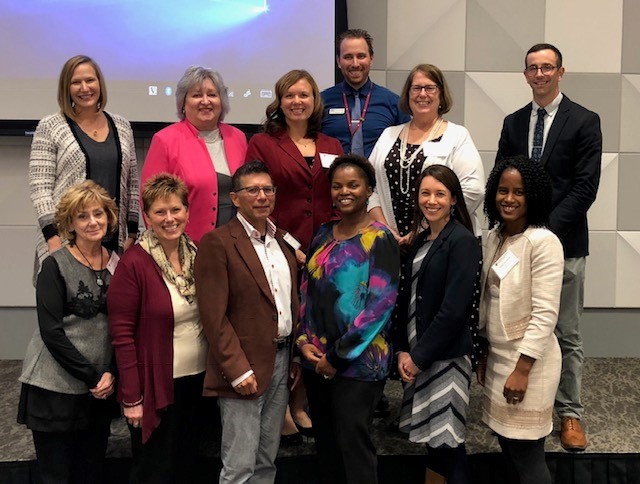
The Planning committee would like to thank all of their sponsors and partners for the event, including the Midwest AIDS Training & Education Center, and the Nebraska Ryan White Part B program.  The committee would also like to thank Deanna Hansen, Deb Justesen and Sara Weber for their hard work in keeping the conference running smoothly throughout the day. You can find more quotes, photos, and audience reactions to the day on Twitter: #UNMCHIV2018, and be sure to follow @UNMC_ID to be the first to hear about future conferences!

An Empiric Nudge in the Right Direction

The following review was originally posted by Dr. Marcelin to the September 2018 SHEA Journal Club and featured on Medscape’s SHEA Expert Commentary earlier this month. 

Use of empiric antimicrobial treatment in acute care settings is often the result of the “diagnosis momentum” heuristic, wherein the antibiotics started in one location for “sepsis” are continued for several additional days after transfer to a second location. Vancomycin remains one of the most commonly prescribed inpatient antibiotics, despite a decline in prevalence of invasive MRSA infections. The authors of the first article “Rate of positive cultures necessitating definitive treatment in patients receiving empiric vancomycin therapy” compared the rate of actual positive culture requiring vancomycin to the rate of vancomycin use in a single-center retrospective observational study. The majority of these infections were SSTIs, bacteremia and pneumonia.

Concern for MRSA is likely the driver of overuse of vancomycin, yet this organism was confirmed in only 8.4% of the positive cultures. Over the three-month period studied, only 11% of 1662 patients on vancomycin had a positive culture necessitating vancomycin use as definitive therapy.  This means that up to 90% of patients on empiric vancomycin can likely be safely de-escalated, especially after 48 hrs. of negative cultures.  However, convincing prescribers to discontinue presents a separate challenge for Antimicrobial Stewardship Programs (ASP).

In the second article, Microbiology Comment Nudge Improves Pneumonia Prescribing, the authors capitalized on the fact that perhaps most decisions to start empiric vancomycin/piperacillin-tazobactam in setting of pneumonia occur in the context of concern for unidentified MRSA or Pseudomonas aeruginosa. Even with negative cultures, are prescribers continuing these antibiotics because of a fear that these bacteria are lurking in the cultures, but missed by the microbiology lab? In active stewardship education, we can tell people “the likelihood that MRSA or pseudomonas is going to be present in a person without specific risk factors is low”. In a complex patient care scenario however, prescribers can talk themselves into the possibility of these bacteria being present even when it highly unlikely. What if the micro lab could say unequivocally that these organisms were absent; would that change practice?

In this quasi-experimental study conducted within a 4-hospital system in Detroit, the microbiology lab cultured respiratory specimens of individuals being treated for pneumonia. The lab made a simple modification to their reporting system for normal “commensal respiratory flora” (which included growth of Neisseria, Corynebacterium and Streptococcus, with no dominant growth of any single organism). The lab added the statement: “No S. aureus/MRSA [methicillin-resistant Staphylococcus aureus] or P.[Pseudomonasaeruginosa” to the report, and the ASP provided a brief education to prescribers.  

After this behavioral nudge was implemented, prescribers were 34% (p<0.01) and 5.5-fold more likely to de-escalate antibiotics than when the report only stated “commensal respiratory flora”. Additionally, with fewer vancomycin/piperacillin-tazobactam combination days of therapy (DOT), they noted a 17% reduction in acute kidney injury (p<0.03) even after adjusting for severity of illness with APACHE II or Charlson comorbidity index scores.  The DOT of MRSA and antipseudomonal therapy was reduced from 7 to 5 days (P<0.01). The authors do not state how long their lab took to finalize cultures, but assuming at least a preliminary result of the “commensal respiratory flora” comment nudge in 48 hrs. even the intervention arm had room for earlier de-escalation, with a median empiric DOT of 5 days. Multidrug-resistant organisms (MDROs) were not generally prevalent in either group, however there was a significant difference in development of subsequent MDROs after the culture result nudge (8% vs 1%, p=0.035). Despite these significant stewardship outcomes, however, no effect on mortality, development of Clostridium difficile infection, or change in length of ICU/hospital stay was observed.

Behavioral nudges use positive reinforcement and indirect messaging to influence decision-making, and exist in many areas of our clinical environment already. Many microbiology labs already include resistance markers in the rapid diagnostic test results, which serve to passively guide prescribers to appropriate antibiotic choices. As ASPs aim to collaborate with prescribers to change behaviors, these behavioral nudges can be a useful low-effort/high-yield tool to further assist with antibiotic de-escalation, even in critically ill patients.

References:

Dustin Waters and Joshua Caraccio Rate of positive cultures necessitating definitive treatment in patients receiving empiric vancomycin therapy. Infection Control & Hospital Epidemiology, Volume 39, Issue 8 August 2018 https://doi.org/10.1017/ice.2018.123

Mary Musgrove et al.  Microbiology Comment Nudge Improves Pneumonia Prescribing. Open Forum Infectious Diseases, Volume 5, Issue 7, 1 July 2018, https://doi.org/10.1093/ofid/ofy162