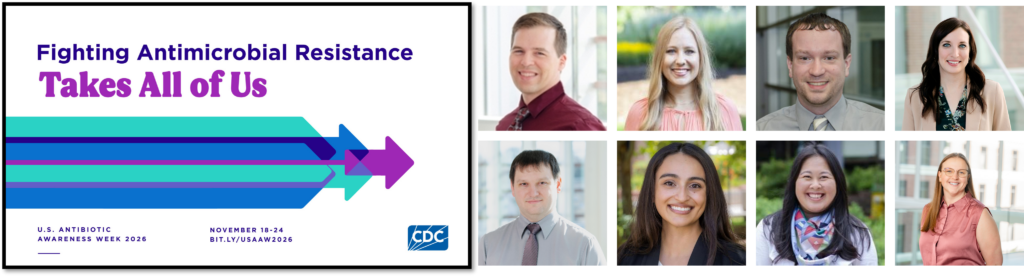
November 18, 2026 begins U.S. Antibiotic Awareness Week. Before we spend the week talking about how we can improve antibiotic use, we want to recognize the pharmacists who help make antimicrobial stewardship happen every day.
At UNMC and Nebraska Medicine, stewardship is built on a partnership between pharmacists and physician leaders, each bringing different expertise to the same goal: providing the most effective antimicrobial treatment while minimizing unnecessary exposure and harm.
Pharmacist expertise is central to stewardship
This partnership is reflected nationally. CDC’s Core Elements of Hospital Antibiotic Stewardship Programs recommends physician-pharmacist co-leadership and identifies pharmacy expertise as a core component of an effective program. In 2025, 99% of U.S. acute-care hospitals reported pharmacy expertise as part of their stewardship programs.
Our pharmacists bring expertise in antimicrobial selection and dosing, pharmacokinetics and pharmacodynamics, drug interactions, therapeutic monitoring, prospective audit and feedback, and antibiotic optimization. That expertise complements physician leadership in infectious diseases, diagnosis, clinical decision-making, and engagement with medical teams.
Our team
Scott Bergman, PharmD, FCCP, FIDSA, BCIDP, serves as Pharmacist Coordinator of our Antimicrobial Stewardship Program and directs the PGY2 Infectious Diseases Pharmacy Residency. Scott works alongside Bryan Alexander, PharmD; Molly Miller, PharmD, BCIDP; Sara Azimi, PharmD, BCIDP; and Danny Schroeder, PharmD, BCPS, whose work spans stewardship, infectious diseases, OPAT, and Nebraska Medicine Bellevue.
Our pharmacy leadership also extends into the community. Jenna Preusker, PharmD, BCPS, coordinates the Nebraska ASAP Outreach Program, and Shawna Sunagawa, PharmD, leads HIV/antiretroviral stewardship. Anna Mills, PharmD, our infectious diseases pharmacy resident, represents the next generation being trained in this work.
The impact of pharmacist involvement is more than theoretical. A recent prospective study of pharmacist-led stewardship within an interprofessional ICU team reported an 89.6% reduction in antimicrobial-related problems, with 98.1% of pharmacist recommendations accepted. While results from a single-center study should not be generalized to every program, they demonstrate what pharmacist expertise integrated into a clinical team can accomplish.
As Antibiotic Awareness Week begins, we are grateful for the pharmacists who bring this expertise to our patients, our clinical teams, and communities across Nebraska every day.
Meet our UNMC/Nebraska Medicine Antimicrobial Stewardship team.