In its six years of existence, the Psychiatric Emergency Services (PES) unit has serviced more than 11,000 patient visits. In addition to providing excellent clinical care, the unit has educated dozens of UNMC medical students and UNMC Department of Psychiatry residents.
In October 2020, during the COVID-19 pandemic, the PES received its first patient seeking emergent mental health care in a safe and compassionate setting. The PES team includes psychiatrists, mental health practitioners, nurses, therapists, and peer support specialists. The unit’s clinical goal is to stabilize patients with immediate psychiatric care and swiftly refer them to the appropriate next step for treatment while avoiding unnecessary inpatient admissions.
The PES is also a crucial location for training the next generation of the psychiatry workforce. Jeana Benton, MD, is an emergency psychiatrist in the PES and a core faculty member of the UNMC Department of Psychiatry Residency Program.
“The Psychiatric Emergency Services rotation is a fantastic learning experience for both residents and medical students,” Dr. Benton said. “From day one, trainees are immersed in a fast-paced, multidisciplinary environment, working alongside psychiatrists, social workers, nurses, and other mental health professionals. The variety of patients they see helps build a broad clinical foundation and sharpens diagnostic thinking, while hands-on experience with risk assessment strengthens one of psychiatry’s most essential — and most challenging — skills.”
Benton added that trainees also learn to navigate the full range of disposition options, from inpatient hospitalization to outpatient follow-up, to community-based referrals, giving them a real feel for how the mental health system works.
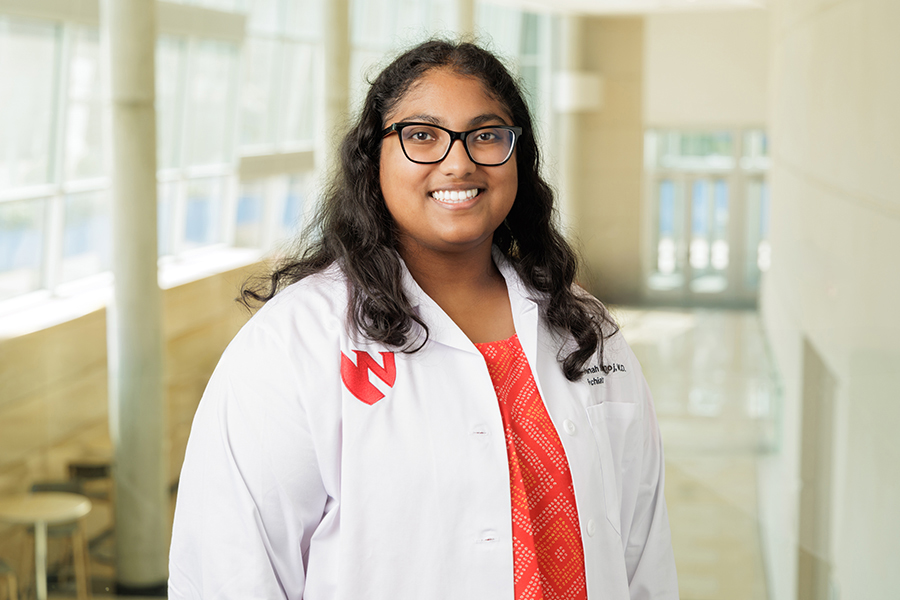
Second-year Psychiatry Resident Hannah Manoj, MD, elected a PES rotation as a UNMC medical student and has worked in the PES as a resident.
“Training in the PES has helped me hone my decision-making skills because you have to think quickly. It’s different than working in long-term inpatient,” Dr. Manoj said. “I like the quick decision-making and risk assessment. I’m really glad we have a PES here at UNMC.”
Matthew Kelly, MD, is the associate program director for the UNMC Department of Psychiatry Residency Program. He said current psychiatry residents must learn about and practice emergency psychiatry as part of their four-year training.
“While rotating in the PES, trainees are allowed to treat high-risk, high-acuity patients based on the principles of trauma-informed care, while also learning how to collaborate with emergency medicine colleagues in a challenging, highly dynamic clinical environment,” Dr. Kelly said.
Stephen Salzbrenner, MD, has worked in the PES for more than five years and has seen firsthand how the PES provides a high-yield learning environment.
“Medical students develop greater confidence in their ability to evaluate suicide risk, with students consistently identifying this as one of the most valuable aspects of their training,” he said.