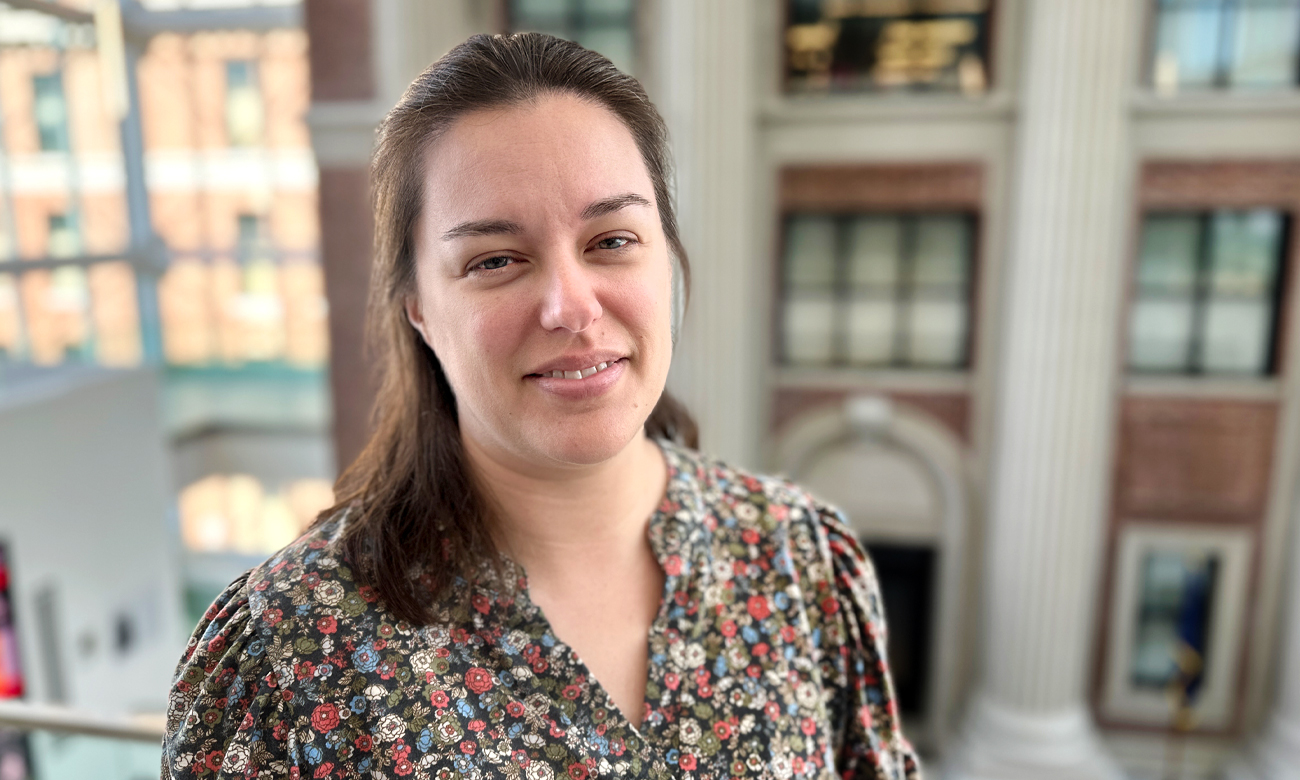
October is American Archives Month as well as National Medical Librarians Month. To celebrate, we’re sharing conversations with just three of the staff members that make McGoogan a shining example of a medical library and an embodiment of the archivist’s job. To begin, get to know Archives Specialist Kelly Gonzalez.
What drew Gonzalez to librarianship, and archives in particular
With overlapping passions for libraries and the study of history, Gonzalez spent time as an undergraduate at Vermont’s Norwich University exploring the possibilities housed in library and museum archive jobs. Her search didn’t, ultimately, help her pick one over the other.
“I didn’t really want to make up my mind—so I didn’t, really,” she said.
Through early jobs in Pennsylvania, Georgia and elsewhere, Gonzalez explored the overlap between types of archivist jobs, acting as a sort of “liaison,” she said.
Highlighting the through lines themselves as she goes, Gonzalez appreciates any role that allows her to help people access information, regardless of collection or era.
“I like to enjoy people’s research and celebrate with them,” Gonzalez said.
She truly loves the process of undertaking the “treasure hunt,” then sending a patron off to the rest of their work and starting over with the next person, she said.
What makes medical libraries and librarianship significant
The work of a health sciences library matters, in part, because literally every person interacts with illness, doctors and health information in some way, Gonzalez said.
And though everyone needs good health information, not everyone can venture into the depths.
The terminology of bodies, ailments and cures can be intimidating, a vocabulary all their own, Gonzalez said. It truly helps to have an intermediary between medical professionals and laypeople; librarians can be these liaisons, leading patrons through big questions.
The ability to translate information across audiences, in this case everyone from students to doctors, researchers to patients, is a particular challenge for health sciences librarians—and commends their work.
“You have to be able to transform yourself, adjust how you communicate with people,” Gonzalez said. “I think I’m good at that.”
The rewards of a recent experience
Looking back at recent projects, Gonzalez relished her visit—alongside Special Collections Curator Darby Kurtz—to an iteration of this summer’s Highlander camp for elementary-aged children in North Omaha. As part of a weeklong focus on medicine, the pair presented on medical illustrations, bringing samples from the McGoogan collection such as models, porcelain doll sculptures, historical drawings, rare books and more.
Gonzalez and Kurtz discussed medical illustration as a form of communication and helped campers think through why an artist might make certain choices. They talked about historical and current developments in the field; the latter encompassing forms like holograms and other computer-designed works.
To work with an audience that would typically never enter the McGoogan space and to, once again, build bridges—between kids and their potential futures, between art and science—felt particularly rewarding to Gonzalez.